.png)


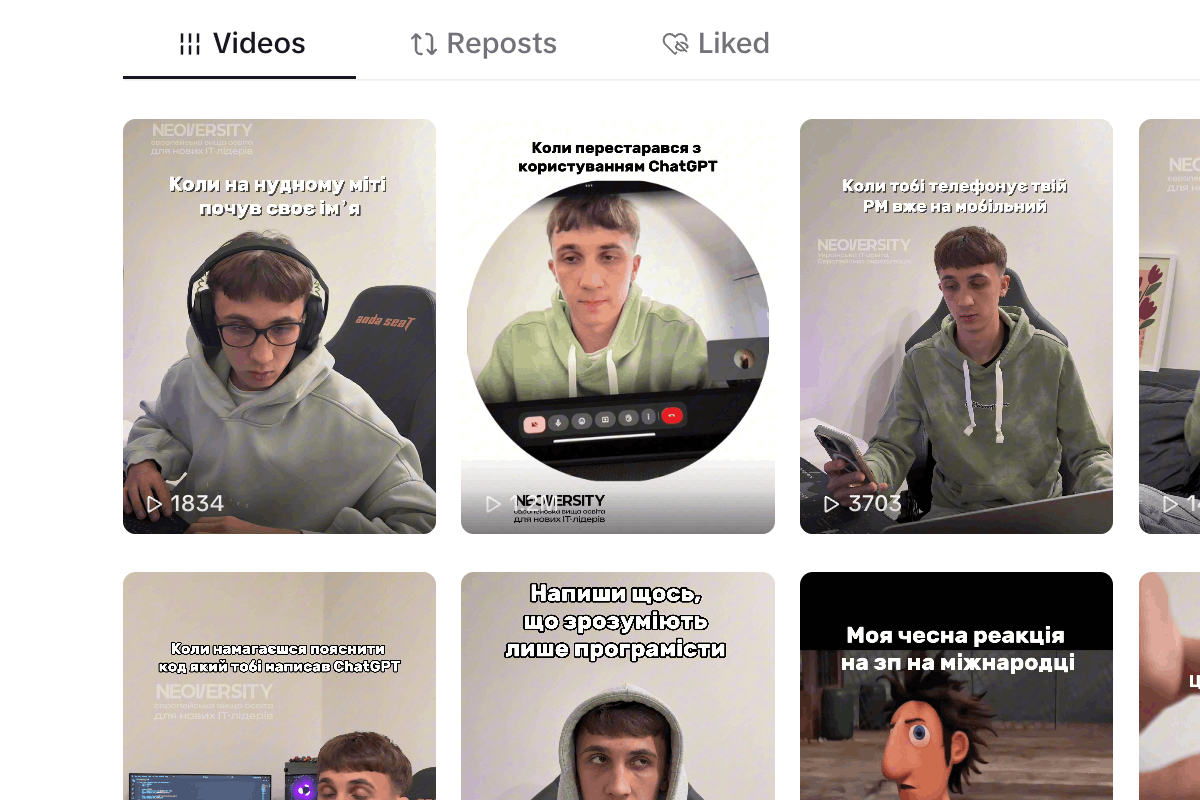
When Neoversity, an online university, came to us with a brand awareness goal in Ukraine, we proposed something most agencies don't offer: a full in-house content factory built around hired UGC creators, daily posting at scale, and a CPM that turned out to be lower than almost any paid channel on the market.
The result? Over 1,000,000 monthly organic impressions across Instagram and TikTok, 1,500,000 total views in two months from zero-follower accounts, and a CPM under $2 — agency fees included.
Here is exactly how we built it, and why this model is one of the most underrated growth plays available to consumer-facing brands in 2026.
Important to note that there is such a thing as "seeding" on social media, which means using thousands of accounts to spread information. It is not bot accounts, but people paid to post about something to create hype, spread a rumor, or launch something new. It is different from making a content factory as using own influencers has a smaller scale to create a viral effect, but produces higher quality content with higher trust and intention from customers.
Neoversity needed brand awareness in Ukraine, and they needed it at a price point that traditional influencer marketing simply couldn't deliver. Paying established Ukrainian influencers at market rates would have eaten the budget within weeks, with limited control over output, frequency, or messaging.
The brief: maximum reach, minimum CPM, full creative control, and a system that could be scaled or paused on command.
Most brands approach short-form video the same way: hire a few influencers, hope something hits, repeat. We took the opposite approach.
We built a content factory — a tightly managed production system where we owned the strategy, scripts, analytics, and distribution, and the creators were focused exclusively on what they do best: showing up on camera and uploading content.
Here is how it worked.
Instead of paying per-post fees to outside influencers, we hired 4 UGC creators directly. They were models in front of the camera. They are not strategists, not editors, not analytics owners. That separation of roles is what made the economics work. They gained a stable income and were paid per video with bonuses for high-performing content.
By bringing creators in-house, we cut content costs to roughly one-fifth of what equivalent influencer placements would have cost on the open market. Bigger volume of content, same production quality, a fraction of the spend.
Each of the 4 creators posted 3 videos daily on both TikTok and Instagram. That means 24 short-form videos shipping every single day, across 8 accounts.
This volume isn't excessive. It's strategic. Short-form video is a probability game. The algorithm rewards consistency, variety, and frequency. Posting once a week and hoping for a viral hit is gambling. Posting 24 times a day with constant analytics feedback is a system.
This is where the agency side did the heavy lifting. Our team handled:
Creators received scripts, recorded the videos, and uploaded them. That was it. They didn't have to think about strategy, analytics, or platform mechanics. So, they could deliver the necessary amount of content per day.
Once we identified the highest-performing organic posts, we used them as creative for paid TikTok ads to drive direct traffic on top of the organic reach. We did not use it for videos that gained 1,000,000 views organically, as it is counterproductive. The combination of organic for cheap awareness and paid ads for targeted traffic is one of the most efficient short-form strategies, and it only works at scale because you have a constant supply of validated creative to test.
Over two months, starting from accounts with zero followers:
For context: a sub-$2 CPM on awareness is below what most brands pay for low-quality programmatic display ads, with vastly higher engagement and brand-building value.
A few principles drove the results.
Multiple creators kill the luck factor. One creator means one personality, one face, one chance at audience-fit. Four creators across eight accounts means dozens of chances per week to find what resonates. Volume is the mechanism for finding the signal by using a prepared strategy.
Posting frequency compounds. Daily posting at scale creates a feedback loop that the algorithm rewards. Three posts per day per platform is the floor for short-form growth.
Constant analytics let us improve month over month. We didn't just publish and hope. Every week, we reviewed which scripts, hooks, and topics drove views and which didn't. The result: views per video went up over time as we learned the audience.
Hiring your own creators is up to 5x cheaper. Paying influencers per post locks you into their rate card and their schedule. Hiring creators directly turns content into a controllable production line.
The whole system is scalable. Want double the reach? Add 4 more creators and 8 more accounts. The strategy, scripts, and analytics infrastructure are already built. Each additional creator slots into the existing factory.
This model isn't right for every business, and we tell prospective clients that directly. A few caveats worth knowing.
Attribution is hard. Awareness campaigns drive brand searches, indirect traffic, and lifts in conversion across other channels — but tracking exactly which TikTok view led to which sign-up is genuinely difficult. If you need clean last-click attribution, this isn't your channel.
It doesn't work for every product. UGC content factories work best for consumer-facing or consumer-adjacent brands with broad market appeal. Highly technical B2B products, niche enterprise tools, or products requiring long sales cycles may not see the same returns.
The main focus is awareness, not direct conversion. We layered paid ads on top to drive traffic, but the core engine here is reach and brand-building. If you need immediate sign-ups this week, this is not the fastest channel.
If you're building a consumer brand, an education platform, an app, a DTC product, or anything that benefits from broad awareness in a specific market, the content factory model deserves a serious look.
The key is execution. Hiring creators is easy. Building the strategy, script pipeline, analytics infrastructure, and quality control around them is what separates a content factory that hits a million impressions a month from one that posts inconsistently and dies in six weeks.
That's the part we own. That's why this works.
Want a content factory built for your brand?